The best event pipeline is usually created before anyone steps onto the show floor. If your team waits until badge scans start, you are competing with every other booth, every packed session, and every tired attendee. Pre-event exhibitor research gives SDRs and event marketers a cleaner way to decide who is worth pursuing, what to say, and how much sales capacity to spend.
That discipline matters more as events get both more important and more scrutinized. Bizzabo's 2025 benchmark report found that 78% of organizers consider in-person events their most impactful marketing channel, while 70% still report difficulty demonstrating ROI for in-person conferences and conventions Bizzabo (2025). The answer is not more random booth traffic. It is better targeting before the event starts.
Start with the exhibitor universe
Begin by pulling the official exhibitor list, sponsor list, floor plan, side-event pages, and agenda partner pages. Do this even if the event site looks incomplete. Early lists usually reveal enough to identify market segments, anchor sponsors, and accounts that are investing heavily in the category.
Build one working list with:
- Company name
- Booth or sponsor tier
- Industry and subcategory
- Website and LinkedIn URL
- Known CRM account owner
- Target-account status
- Notes on why the company may be attending
This first pass is not about perfection. It is about turning a public event page into a prospecting dataset. From there, your team can enrich accounts, remove bad fits, and prioritize the exhibitors that deserve real outreach.
Score for ICP fit before you research contacts
Many teams jump straight from "company is exhibiting" to "find the VP of Sales." That wastes time. Exhibiting at a show is a signal, but it is not enough by itself.
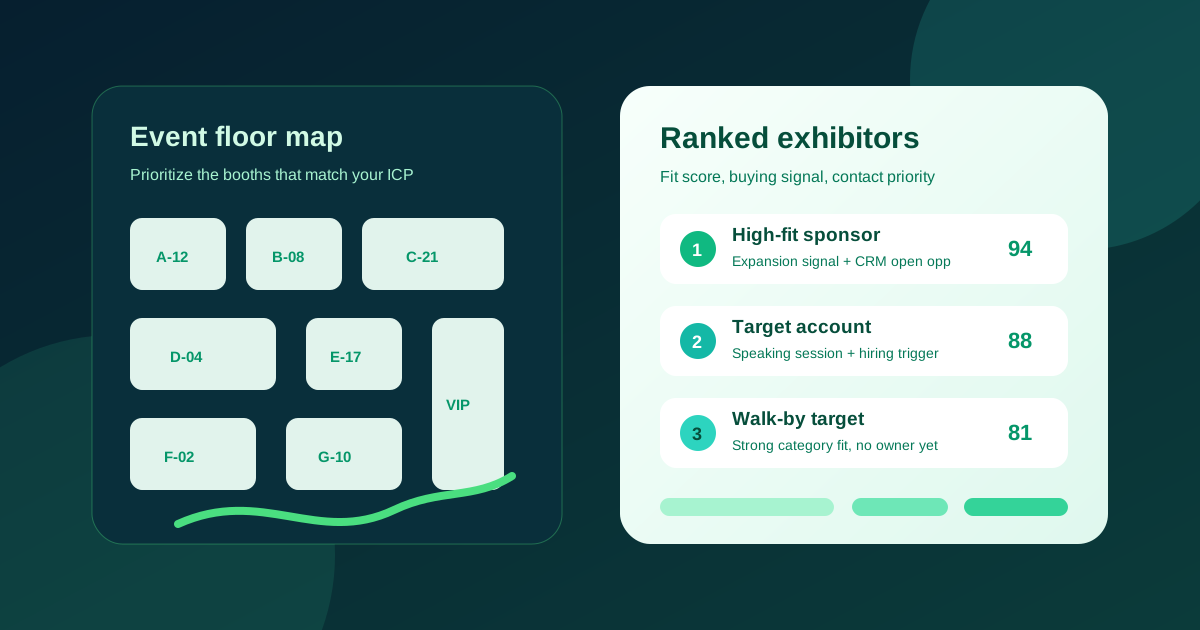
Score account fit first. A simple model can work:
- Firmographic fit: company size, geography, vertical, funding stage, or technology stack.
- Event relevance: sponsor tier, booth size, session participation, product launches, or side-event involvement.
- Commercial signal: hiring, expansion, recent funding, new markets, or category momentum.
- CRM context: open opportunity, dormant account, customer expansion potential, or competitor relationship.
Scryon's platform is built around this kind of event intelligence: start with the event, reveal the companies and contacts that matter, then rank them by fit. The point is to help reps spend their limited event time on accounts where a conversation can realistically become pipeline.
Research the buying angle
Once you have a ranked exhibitor list, write a short hypothesis for each priority account. This is the sentence your rep should be able to use when starting outreach:
"You are exhibiting at this show because you are trying to reach [audience]; we help teams like yours [specific outcome] before, during, or after the event."
That hypothesis should come from evidence, not guesswork. Read the exhibitor's event description, recent product news, hiring pages, partner announcements, and any sessions they are hosting. Freeman's 2025 commercial trends report found that 74% of attendees say in-person events are the best place to discover new products, and 84% say access to subject matter experts is crucial Freeman (2025). If buyers are coming to learn and compare, your outreach should show that you understand why the exhibitor is there.
For SDRs, that means replacing generic "will you be attending?" copy with event-specific relevance:
- "I saw you are exhibiting in the security pavilion."
- "Your team is speaking on supply-chain resilience."
- "You are launching the new partner program at the show."
- "Several companies in your category are clustered near your booth."
Those details make the outreach feel connected to the prospect's actual event investment.
Spend credits where they change the outcome
Credit economics matter because not every exhibitor deserves the same level of enrichment. A large event may have hundreds or thousands of exhibiting companies. Revealing every contact can burn budget without improving outcomes.
Use credits in layers:
- Free research layer: collect public exhibitors, sponsors, sessions, and side events.
- Account-fit layer: use event intelligence to identify which companies match your ICP.
- Contact layer: reveal decision-makers only for high-fit accounts.
- Execution layer: route those contacts to SDRs, AEs, or field marketers with the right context.
This is where pricing should be part of event planning, not an afterthought. Estimate how many exhibitors you need to score, how many contacts you need to reveal, and how many meetings your team can actually handle. If one AE can hold eight strong meetings at a show, revealing 300 contacts for that rep is usually less useful than revealing the right 40.
Turn the list into meetings
The final output should be a ranked working list, not a spreadsheet graveyard. Give each rep a short action plan:
- Top 10 must-meet exhibitors
- Next 20 nurture or walk-by targets
- Suggested contact per account
- Outreach angle
- Booth or event location
- CRM status and owner
- Follow-up task date
Then sequence outreach before calendars fill up. MarketingWeek reported that 69% of B2B event leaders saw event budgets stay flat or decrease in 2025, even as costs continued to rise MarketingWeek (2025). When teams have to do more with less, booked meetings beat hoping the right person walks past the booth.
For sales teams, Scryon's sales workflow helps turn event research into rep action: identify the right accounts, understand why they matter, and arrive with a plan.
Further reading
- Bizzabo State of Events and Industry Benchmarks: current data on in-person event impact, attendance growth, and ROI measurement gaps.
- Freeman 2025 Commercial Trends Report announcement: buyer expectations around product discovery and expert conversations at live events.
- MarketingWeek on 2025 B2B event budgets: context on flat or shrinking event budgets and the need for sharper prioritization.
Ready to turn an exhibitor list into a meeting plan? Book a discovery call, or start by exploring how Scryon helps teams prioritize the right accounts on the platform.